Is the Effeuno Pulse the ultimate indoor electric pizza oven for home pizza makers? I’m putting this Italian-made pizza oven through a variety of real-world baking tests to find out.
I’ve tested more than 25 pizza ovens over the years, including several indoor electric pizza ovens. Between my years working in pizzerias, reviewing pizza for NEPA Pizza Review, making pizza at home, and teaching pizza-making classes through Virtual Pizza Academy, I’ve developed an appreciation for the different strengths and weaknesses of pizza ovens.
There is no single pizza oven that is perfect for everyone. Much depends on the styles of pizza you enjoy making, your budget, your available space, and how much control you want over the baking process.
The Effeuno Pulse is an oven I’ve been particularly excited to get my hands on. Its heavy-duty construction, unusually thick refractory stone, minimalist controls, and unique single-heating-element design make it quite different from other electric pizza ovens I’ve tested.
Rather than waiting until I’ve completed all of my testing to publish a review, I’m treating this article as a living review of the Effeuno Pulse. I’ll continue updating it with photos, baking results, observations, temperature recommendations, and lessons learned as I become more familiar with the oven.
Disclosure: I received the Effeuno Pulse to test as part of a content collaboration. This article contains affiliate links, and I may earn a commission if you make a purchase through them. The observations and opinions shared here are based on my own baking experiences.
Save 10% on Effeuno pizza ovens at PizzaGoods with promo code NEPA10.
Shop Effeuno Pizza Ovens at PizzaGoods
What Is the Effeuno Pulse Pizza Oven?
The Effeuno Pulse is an Italian-made, high-temperature indoor electric pizza oven designed to bring professional-style pizza baking capabilities into the home.
While high-temperature electric pizza ovens are frequently marketed toward people looking to make authentic Neapolitan pizza, I’m equally interested in their ability to bake New York-style pizza, Sicilian pizza, Detroit-style pizza, and other regional pizza styles that require very different baking environments.
Living in Northeastern Pennsylvania, where we have an incredibly diverse pizza culture, versatility is particularly important to me. I want to know whether an oven can produce a beautifully blistered round pizza one night and a crispy, evenly baked pan pizza the next.
Effeuno Pulse Features at a Glance
| Feature | Description |
|---|---|
| Country of manufacture | Italy |
| Oven type | Indoor electric pizza oven |
| Electrical connection | Standard U.S. 110–120V three-prong connection |
| Heating system | Single upper heating element |
| Baking surface | Approximately 25mm thick refractory stone |
| Oven door | Triple-pane glass |
| Temperature display | Fahrenheit on the U.S. model |
| Temperature controls | Digital, adjustable in 1°F increments |
| Preset pizza programs | None |
| Construction | Heavy-duty metal housing |
What makes this oven particularly interesting is not necessarily any one of these features, but how they work together to create a baking environment that feels quite different from other indoor pizza ovens.
Unboxing the Effeuno Pulse
The first thing I noticed about the Effeuno Pulse was its weight. The shipping box weighed approximately 71 pounds, and it became immediately apparent that this wasn’t going to be a lightweight countertop appliance.
My particular oven was shipped via FedEx as an experimental shipment. There were a couple of things about the packaging that I felt could be improved.
The cardboard feet designed to accommodate palletization had collapsed during shipping, and because the oven wasn’t enclosed in a protective plastic bag, there were small Styrofoam particles clinging to the exterior of the oven due to static electricity.
Neither issue resulted in damage to my oven or stone, but I shared my observations with PizzaGoods and the manufacturer.
I was subsequently informed that packaging improvements had been implemented and that customer ovens would be shipped via freight. My shipping experience should therefore not necessarily be considered representative of what customers will experience when ordering an Effeuno Pulse.
Build Quality and First Impressions
The best way I can describe the Effeuno Pulse is that it’s built like a tank.
The oven has a substantial, heavy-duty metal construction that reminds me more of a piece of commercial kitchen equipment than a typical consumer countertop appliance.
Having handled and tested a variety of portable pizza ovens, I immediately noticed the difference in the overall feel of the materials and construction.
There is something reassuring about the simplicity and sturdiness of the design. It doesn’t feel like an oven that was designed around flashy features or unnecessary technology. It feels like an oven designed to bake pizza.
Triple-Pane Glass Oven Door
Another feature that caught my attention was the triple-pane glass door.
The three layers of glass are designed to help retain heat inside the baking chamber while reducing heat transfer to the exterior of the door.
I also appreciate being able to watch the pizza bake without opening the door. Observing oven spring, cheese melting, crust browning, and topping caramelization is a big part of learning how to use any new pizza oven.
I haven’t yet conducted formal exterior surface temperature testing, but the door construction is noticeably substantial.
The Massive Refractory Pizza Stone
Perhaps the most distinctive feature of the Effeuno Pulse is its baking stone.
At approximately 25mm thick, the refractory stone is about 150% thicker than a typical 10mm pizza stone found in many portable pizza ovens.
It’s also quite heavy!
The thickness of the stone is particularly important because the Pulse does not have a separate lower heating element. Instead, the stone absorbs and stores thermal energy from the oven’s upper heating element.
That stored energy is then transferred into the bottom of the pizza during the bake.
A stone with substantial thermal mass has the potential to offer several advantages:
- Better heat retention when a pizza is launched.
- More consistent bottom browning.
- Less dramatic temperature fluctuations between pizzas.
- Improved performance when baking multiple pizzas consecutively.
- A stable source of bottom heat for pan pizzas.
Of course, a thicker stone also requires sufficient time to absorb heat throughout its mass. Just because the oven’s digital display reaches your desired temperature doesn’t necessarily mean the stone is fully saturated with heat.
This is something I’ve been paying close attention to throughout my testing.
Why Does the Effeuno Pulse Only Have One Heating Element?
One of the things that initially intrigued me about the Pulse was its single-heating-element design.
Several indoor electric pizza ovens I’ve used have separate upper and lower heating elements, sometimes with independently adjustable temperature controls.
The Effeuno Pulse takes a different approach.
The heating power is concentrated in the upper element rather than divided between two elements. The upper element provides radiant heat to bake the top of the pizza while the thick refractory stone stores energy to bake the bottom.
At first, I wondered whether the lack of a separate lower heating element would limit my ability to control the balance between top and bottom heat, particularly when baking styles other than Neapolitan pizza.
What I’m discovering is that there are some very effective ways to manipulate that balance using the stone temperature and the oven’s temperature setpoint.
I’ll explain some of the techniques I’ve been experimenting with later in this review.
Effeuno Pulse Setup
Setting up the Effeuno Pulse is remarkably simple.
Once you’ve removed the packaging and placed the oven on an appropriate heat-resistant surface with the required clearances, the primary assembly step is installing the refractory stone.
The stone rests on top of the front and rear support ledges inside the oven, leaving an air gap underneath it.
This is an important distinction because the stone should not be wedged between those ledges. It should sit on top of them.
The installation instructions could have been a little clearer in this regard, and I shared that feedback with the manufacturer.
Beyond installing the stone, there really isn’t much assembly required. The U.S. model features a standard three-prong electrical connection, although you’ll want to ensure that your electrical circuit meets the manufacturer’s requirements.
Before making your first pizza, however, there is one very important step you should not skip: curing the refractory stone.
How to Cure the Effeuno Pulse Pizza Stone
Because the refractory stone is thick and porous, it can contain residual moisture that needs to be gradually released before exposing it to extremely high baking temperatures.
After speaking with Pasquale at PizzaGoods, I was instructed to begin the curing process at 200°F and gradually increase the temperature by 100°F every 20 minutes until reaching the oven’s maximum temperature.
I elected to be a little more conservative and increased the temperature every 30 minutes.
What I found particularly fascinating was that I could actually see moisture being released from the stone during the curing process.
Small droplets of water began forming near the bottom of the oven door glass during the early stages of heating. As the temperature increased, those droplets eventually disappeared.
It was a very visible demonstration of why this curing process is important.
Pasquale explained that gradually removing the moisture helps preserve the integrity and shape of the refractory stone. Rapidly heating an uncured stone could potentially cause it to warp, resulting in an uneven baking surface.
Considering the investment you’re making in this oven, taking the time to properly cure the stone is well worth it.
Always follow the manufacturer’s current curing instructions before your first bake.
Watch My Effeuno Pulse Unboxing, Setup and Stone Curing Video
[INSERT YOUTUBE VIDEO EMBED HERE]
In this video, I walk through the unboxing, discuss my initial impressions of the build quality, demonstrate how to properly install the refractory stone, and take you through the curing process.
Effeuno Pulse Temperature Controls and User Experience
One of my favorite things about the Effeuno Pulse so far is its simplicity.
The controls consist of a main power switch, a power button, and up and down temperature adjustment buttons.
That’s essentially it.
You can press and hold the temperature buttons to move quickly through the temperature range or tap them individually to adjust the temperature in 1°F increments. There is no additional confirmation step required after changing the temperature.
No Preset Pizza Programs — And I Like That
Some modern pizza ovens feature preset programs for different styles of pizza, such as Neapolitan, New York, thin crust, or pan pizza.
Personally, I don’t place much value on these presets.
Two people making New York-style pizza might use completely different dough formulations, hydration levels, fermentation schedules, toppings, and baking preferences.
Even something as simple as the amount of sugar or malt in a dough can dramatically impact how quickly a pizza browns.
I’d much rather have direct control over the temperature and learn how the oven responds to my adjustments.
In some ways, using the Effeuno Pulse reminds me of adjusting the flame knob on an outdoor gas pizza oven. Instead of adjusting the intensity of a flame, however, I’m adjusting a precise digital temperature setpoint to influence when the upper heating element is actively heating.
The more I use the oven, the more I’m appreciating that approach.
A Surprisingly Quiet Electric Pizza Oven
Something else that stood out immediately was how quiet the Effeuno Pulse is.
Other electric pizza ovens I’ve tested have produced noticeable whirring, buzzing, or fan noise during operation.
The Pulse is virtually silent by comparison.
It’s not necessarily something that will affect the quality of your pizza, but it’s a feature I appreciate when baking indoors, having conversations, or filming pizza-making videos.
How Quickly Does the Effeuno Pulse Heat Up?
My initial impression is that the Effeuno Pulse heats up remarkably quickly.
During my first bake, I set the oven to 600°F, and the digital display reached that temperature in less than 15 minutes.
I then allowed the oven to continue heating for approximately another 15 minutes to give the refractory stone more time to absorb energy.
When I measured the stone with my infrared thermometer immediately before launching the pizza, it registered 621°F.
It’s important to distinguish between the temperature displayed on the oven’s control panel and the actual temperature of the baking surface.
The thermostat measures temperature within the oven chamber, while an infrared thermometer measures the surface temperature of the stone. These temperatures aren’t necessarily going to be identical.
I’ll be conducting more structured preheating tests at various temperatures to better understand how long the stone takes to become fully heated and ready to bake.
My First Pizza in the Effeuno Pulse
For my first bake, I decided to start somewhat conservatively.
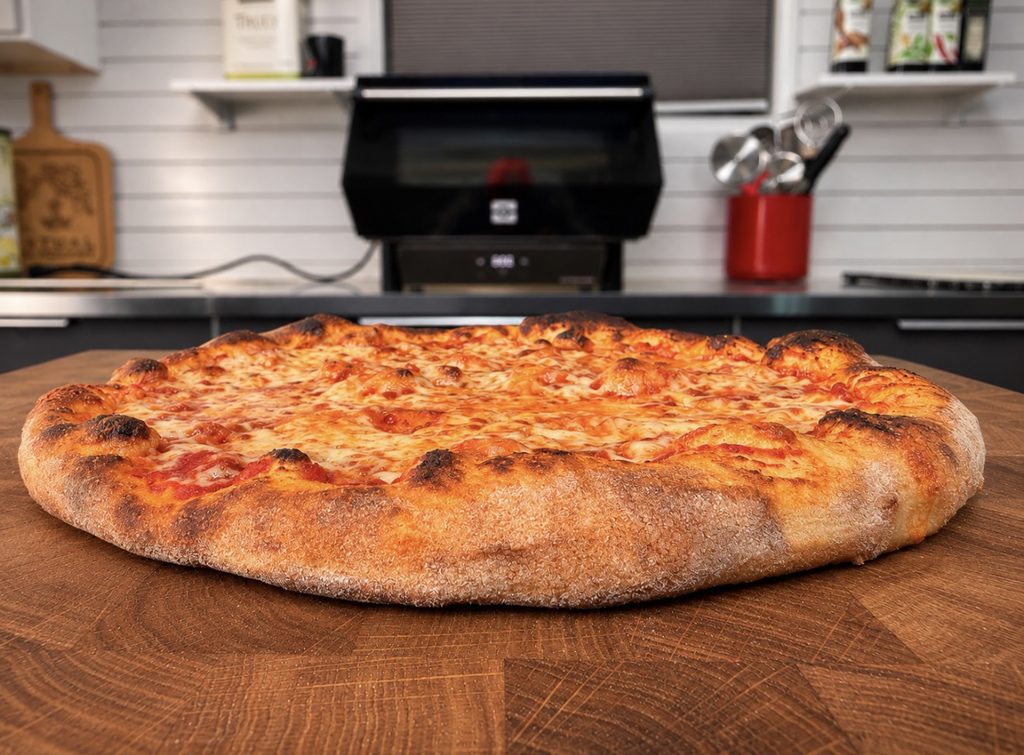
Rather than making a traditional high-temperature Neapolitan pizza, I made a 12-inch New York/Neapolitan hybrid cheese pizza using a dough formulation I typically bake in my conventional home oven at 550°F.
The dough contains malt to help promote browning at conventional oven temperatures, so I didn’t want to immediately expose it to extremely high temperatures.
I topped the pizza with a simple pizza sauce and Grande whole milk mozzarella.
With the oven set to 600°F and the stone measuring 621°F, I launched my first pizza.
Incredible Oven Spring
The first thing that caught my attention was the oven spring.
The outer crust inflated almost like someone was pumping air into a tire. I’ve made hundreds of pizzas with this particular dough formulation in conventional home ovens and outdoor pizza ovens, and I don’t recall seeing it respond quite like this.
The cheese melted quickly, and the crust began developing beautiful color and small blisters within the first minute.
The bake appeared remarkably even. I rotated the pizza 180 degrees approximately halfway through the bake, largely out of habit.
I was so focused on watching the pizza bake that I neglected to time it, but I’d estimate the total baking time was around five minutes.
A Unique Crust Texture
What impressed me most about that first pizza was the texture of the crust.
It was incredibly light, with a delicate, almost eggshell-like exterior that crackled when I bit into it without being excessively hard or brittle.
The crust had beautiful golden-brown coloration with some light charring and blistering.
The bottom was nicely browned and reminded me somewhat of a pizza baked in a traditional Bakers Pride deck oven. For my personal preference, however, I would have liked a little more aggressive browning and crispness underneath.
That’s not a criticism of the oven so much as an opportunity to adjust my technique.
My immediate thought was to experiment with preheating the stone to a higher temperature and then lowering the oven’s temperature setpoint before launching the pizza to achieve a more aggressive bottom bake.
Even with room for improvement, I considered that first pizza an overwhelming success. From a baking-quality perspective and based on my personal preferences, it was better than the vast majority of pizzas I’ve made in other home pizza ovens.
Baking Multiple Pizzas Back-to-Back
One of the most important performance characteristics of any pizza oven is how well it recovers between pizzas.
An oven might bake a spectacular first pizza, but if you have to wait an extended period of time for the stone to recover before launching another one, it can become frustrating when you’re cooking for family and friends.
This is where I’m beginning to see some real benefits from the thick refractory stone in the Effeuno Pulse.
During one of my testing sessions, I baked three pizzas consecutively, including a New York-style pepperoni pizza.
I was working with a stone temperature of approximately 700°F and monitored the surface temperature with an infrared thermometer throughout the process.
Naturally, the stone temperature dipped after removing each pizza. However, by the time I had finished preparing the next pizza, the stone had recovered to approximately 700°F.
I didn’t have to stand around waiting for the oven to recover.
What impressed me was not only how quickly the stone recovered, but also how well it appeared to retain its heat in the first place.
I’ll be documenting this more scientifically in future tests, but my initial real-world experience with consecutive bakes has been very positive.
Baking Sicilian Pizza in the Effeuno Pulse
As someone who makes a considerable amount of pan pizza, I was particularly interested in how the Effeuno Pulse would handle Sicilian pizza.
A thick Sicilian pizza requires a very different baking environment than a thin Neapolitan pizza. You need enough time and heat to develop a light, airy interior while creating a crispy bottom and properly melting and caramelizing the cheese and toppings.
I also frequently use a two-stage baking process for Sicilian pizza, par-baking the crust before dressing it and completing the final bake.
Par-Baking a Sicilian Pizza Crust at 500°F
For my first Sicilian pizza in the Pulse, I used a 10×10-inch aluminum LloydPan.
I preheated the oven to 500°F and made sure the thermostat had reached the desired temperature and was no longer actively calling for heat before inserting the pan.
My objective was to avoid immediately blasting the top of the dough with intense radiant heat and instead utilize the more moderate heat already stored in the oven and stone.
The upper element can still cycle on as needed to maintain the temperature, but timing the launch this way worked particularly well for me.
The par-baked shell came out beautifully and uniformly baked.
The bottom had developed a nice golden-brown color, while the top had a lighter, evenly browned appearance.
I removed the shell and allowed it to cool and release moisture before dressing the pizza.
Creating a Broiler Effect for the Final Bake
I dressed the Sicilian with pizza sauce, mozzarella, sausage, pepperoni, onions, sliced cherry peppers, additional cheese, and Italian seasoning.
For the final bake, I brought the oven to 550°F and confirmed that the stone also measured 550°F.
Immediately after placing the dressed pizza into the oven, I increased the temperature setpoint to 650°F.
The idea was to prompt the upper heating element to deliver more intense radiant heat, creating something similar to a broiler effect while the stone continued to provide a more moderate source of bottom heat.
I could immediately see the cheese beginning to caramelize and the toppings crisping up as the oven worked toward the higher temperature.
The results were fantastic.
The finished Sicilian featured a beautifully crisp bottom, a light and airy open crumb, gooey melted mozzarella, and nicely caramelized cheese and toppings.
It was pretty much everything I look for in a Sicilian pizza.
My Second Sicilian Pizza: Loaded Cup-and-Char Pepperoni
My next Sicilian pizza was absolutely piled high with Hormel Rosa Grande cup-and-char pepperoni.
I started with a par-baked shell that had developed a light tan color on the bottom, just bordering on brown.
I dressed it with cold pizza sauce, mozzarella, stripes of sauce on top of the cheese, and a generous amount of pepperoni.
This time, I launched the pizza with the stone measuring 600°F and immediately increased the oven’s temperature setpoint to 650°F.
Man, did those pepperonis curl up beautifully!
The edges of the pepperoni developed that wonderful char, the cheese caramelized, and the pizza was still sizzling like crazy when I pulled it out of the oven.
The bottom was beautifully crisp and evenly baked from edge to edge.
It was another outstanding bake and further demonstrated to me how capable this oven can be when baking pan pizzas.
Learning to Control Top and Bottom Heat in the Effeuno Pulse
One of the most interesting things I’ve learned so far is that the Effeuno Pulse offers more flexibility in managing top and bottom heat than its single-element design might initially suggest.
While you cannot independently set upper and lower heating element temperatures, you can influence the balance of heat by understanding two variables:
- The actual surface temperature of the refractory stone.
- The temperature setpoint of the oven and whether the upper heating element is actively calling for heat.
For example, when I want to par-bake a Sicilian crust, I’ve had success allowing the oven to reach its target temperature before inserting the pan.
When I want to aggressively caramelize cheese or crisp up pepperoni, I’ve had success increasing the temperature setpoint immediately after launching the pizza.
Conversely, I’m interested in experimenting more with preheating the stone to a higher temperature and then lowering the temperature setpoint at launch when I want to emphasize bottom browning without exposing the top to as much immediate radiant heat.
These techniques don’t provide completely independent top and bottom temperature control, but they do give me some useful ways to influence the baking environment.
My Effeuno Pulse Baking Temperature Guide So Far
| Pizza or baking technique | Starting temperature | Adjustment at launch |
|---|---|---|
| NY/Neapolitan hybrid cheese pizza | 600°F setpoint / 621°F stone | None |
| Consecutive NY-style pizza bakes | Approximately 700°F stone | Varied during testing |
| Sicilian crust par-bake | 500°F oven setpoint | None |
| Loaded Sicilian final bake | 550°F stone | Increase setpoint to 650°F |
| Cup-and-char pepperoni Sicilian | 600°F stone | Increase setpoint to 650°F |
These are starting points based on my own dough formulations, pans, toppings, and preferred level of doneness. They aren’t universal temperature recommendations for every pizza recipe.
I’ll continue expanding this guide as I test more pizza styles.
Getting to Know the Personality of the Oven
One of the things I’ve always enjoyed about getting a new pizza oven is learning its personality.
Every oven is a little different. Understanding how it responds to temperature adjustments, how it retains heat, how quickly it browns a pizza, and how it handles different dough formulations is part of the fun for me.
Recently, we’ve been making a pizza or two almost every night in the Pizza Garage and sending them to school with the Pizza Prince to share with one of his teachers.
It’s given me a great excuse to keep experimenting with the Effeuno Pulse.
What has been particularly satisfying is that it seems like every pizza is coming out a little better than the last.
That’s not because the oven is changing. It’s because I’m becoming more familiar with the temperatures, setpoints, and techniques necessary to achieve the baking characteristics I’m looking for with each style of pizza.
That’s also why I don’t believe a comprehensive pizza oven review should necessarily be based on making just one or two pizzas.
It takes time to understand what an oven is capable of, and sometimes the most interesting discoveries happen after you’ve moved beyond the initial learning curve.
What I Like About the Effeuno Pulse So Far
- Excellent build quality: Heavy-duty construction with a commercial equipment feel.
- Simple controls: Precise temperature adjustments without unnecessary preset programs.
- Thick refractory stone: Impressive early results in heat retention and recovery.
- Rapid preheating: The oven chamber reaches moderate pizza baking temperatures surprisingly quickly.
- Excellent oven spring: Particularly noticeable with a familiar dough formulation.
- Beautiful crust development: Light, airy interiors with delicate, crisp exteriors.
- Even baking: I’ve experienced very uniform browning, particularly with Sicilian pizza.
- Versatility: Early testing has demonstrated excellent results with both round and pan pizzas.
- Quiet operation: Virtually silent compared with several other electric ovens I’ve tested.
- Indoor convenience: Being able to experiment with pizza at night without going outdoors is something I appreciate.
Potential Drawbacks and Things to Consider
Although my experience has been overwhelmingly positive so far, there are some things prospective buyers should consider.
Size and Weight
This is a substantial piece of equipment.
If you’re looking for a lightweight pizza oven that you can easily move in and out of storage every time you want to bake, the Pulse may not be the most convenient option.
You’ll want to have an appropriate location and a sturdy surface capable of supporting the oven.
No Independent Top and Bottom Heating Elements
If you’re accustomed to an electric pizza oven with independently controlled upper and lower heating elements, the Pulse will require a somewhat different approach.
I’m enjoying learning how to manipulate the temperature setpoints to influence the balance of heat, but there is a learning curve.
Stone Curing and Preheating
The thick refractory stone requires an initial curing process and sufficient preheating time.
Although the oven chamber heats quickly, it’s important to allow the stone to absorb enough thermal energy for your intended baking style.
An infrared thermometer is a particularly useful tool when learning how to use this oven.
Pizza Size Limitations
The baking chamber will naturally limit the size of the pizzas and pans you can use.
As someone who enjoys making larger New York-style pizzas and traditional rectangular Northeastern Pennsylvania pizzas, I’ll be exploring how much flexibility the available baking space provides.
Long-Term Performance Is Still Being Evaluated
I haven’t owned the oven long enough to comment on its long-term durability, maintenance requirements, or performance after hundreds of bakes.
Those are things I’ll continue monitoring as part of this ongoing review.
Who Is the Effeuno Pulse Pizza Oven For?
Based on my experience so far, I think the Effeuno Pulse is particularly interesting for enthusiastic home pizza makers who enjoy experimenting with different pizza styles and want a substantial, dedicated indoor electric pizza oven.
It may appeal to people who:
- Want to bake pizza indoors throughout the year.
- Enjoy both high-temperature round pizzas and moderate-temperature pan pizzas.
- Frequently bake multiple pizzas for family and friends.
- Appreciate straightforward controls and durable construction.
- Want to develop their own baking techniques rather than rely on automated pizza programs.
- Enjoy learning about dough, fermentation, heat management, and the science of pizza making.
I’m not suggesting that everyone needs an oven of this caliber to make excellent pizza. I’ve made some fantastic pizzas in a conventional home oven with a baking steel and in relatively inexpensive portable pizza ovens.
The question is whether the features and baking capabilities of the Effeuno Pulse align with the types of pizza you want to make and the way you enjoy making them.
My Preliminary Effeuno Pulse Review and Verdict
At this stage of my testing, the Effeuno Pulse has exceeded my expectations.
I expected it to perform well with high-temperature round pizzas. What has surprised me most is how well it has performed with Sicilian pizza, how effectively the thick refractory stone retains and recovers heat, and how much control I’m able to achieve through relatively simple temperature adjustments.
The build quality is impressive, the controls are refreshingly straightforward, and the baking results have been consistently excellent.
Perhaps the biggest compliment I can give the oven at this point is that I genuinely look forward to turning it on and making another pizza.
I’m finding myself thinking about different styles, recipes, and baking techniques I want to try, which is exactly what I enjoy about testing a new pizza oven.
I’m not ready to declare it the best electric pizza oven I’ve ever tested without completing a more comprehensive series of bakes and performance tests.
However, it has certainly made a very strong first impression.
Interested in purchasing an Effeuno Pulse or another Effeuno pizza oven?
Visit PizzaGoods and use my exclusive promo code NEPA10 to save 10% on Effeuno pizza ovens.
Pizzas I’ve Baked in the Effeuno Pulse So Far
I’ll continue updating this photo gallery as I experiment with different pizza styles, dough formulations, temperatures, toppings, and baking techniques.
New York/Neapolitan Hybrid Cheese Pizza
[INSERT PIZZA PHOTO]
My first bake in the Effeuno Pulse. Incredible oven spring, beautiful blistering, and an exceptionally light crust with a delicate, crackling exterior.
New York-Style Pepperoni Pizza
[INSERT PIZZA PHOTO]
Part of a three-pizza consecutive baking session that demonstrated the impressive heat retention and recovery capabilities of the thick refractory stone.
Loaded Sicilian Pizza
[INSERT PIZZA PHOTO]
A light and airy Sicilian pizza baked in a 10×10 LloydPan and topped with mozzarella, sausage, pepperoni, onions, sliced cherry peppers, and Italian seasoning. Par-baked at 500°F and finished using a 550°F to 650°F temperature adjustment.
Cup-and-Char Pepperoni Sicilian Pizza
[INSERT PIZZA PHOTO]
A crispy, evenly baked Sicilian pizza loaded with Hormel Rosa Grande pepperoni. Launched with a 600°F stone temperature before increasing the setpoint to 650°F to encourage cheese caramelization and pepperoni charring.
What’s Next? My Effeuno Pulse Pizza Oven Testing Plan
I’ve only scratched the surface of what I want to accomplish with this oven.
Over the coming weeks and months, I plan to continue testing a variety of pizza styles and documenting the performance characteristics of the Effeuno Pulse.
Additional Pizza Styles I Plan to Test
- Traditional Neapolitan pizza
- New York-style pizza
- Pan-fried Sicilian pizza
- Old Forge-style pizza
- Detroit-style pizza
- Grandma pizza
- Thin and crispy tavern-style pizza
- New Haven-inspired pizza
- Traditional Sicilian sfincione
- Calzones and stromboli
I’m particularly interested in how the oven performs with Northeastern Pennsylvania’s regional pizza styles, many of which require baking techniques that differ considerably from traditional Italian pizza.
Additional Performance Testing
I also want to conduct more structured testing to answer some of the questions that prospective Effeuno Pulse owners may have.
- Preheating times: How long does the stone take to reach various baking temperatures?
- Maximum temperature performance: How does the oven perform at the upper end of its temperature range?
- Stone temperature consistency: Are there noticeable hot or cool spots across the baking surface?
- Back-to-back baking: How many pizzas can I bake consecutively without significant recovery time?
- Top and bottom heat management: What temperature strategies work best for different styles of pizza?
- Pan compatibility: Which pan sizes and materials work best inside the oven?
- Energy consumption: How much electricity does the oven use during preheating and baking?
- Exterior temperatures: How hot do the door, housing, and surrounding surfaces become during extended use?
- Cleaning and maintenance: How easy is it to maintain the oven and refractory stone?
- Long-term durability: How does the oven hold up after frequent use?
- Electric pizza oven comparisons: How does the Pulse compare with other indoor electric pizza ovens I’ve tested?
I’ll continue updating this article as I gather more information and develop a better understanding of the oven.
What Would You Like to Know About the Effeuno Pulse?
If you’re considering purchasing an Effeuno Pulse, already own one, or are simply interested in electric pizza ovens, I’d love to hear from you.
Is there a particular pizza style you’d like me to bake? A temperature experiment you’d like me to conduct? A feature you’d like me to demonstrate? Another pizza oven you’d like me to compare it with?
Leave a comment below or reach out to me through NEPA Pizza Review on social media.
One of my goals with this ongoing review is to provide useful, real-world information that helps home pizza makers determine whether this is the right oven for them, while also helping existing Effeuno owners get the most out of their ovens.
As always, I’ll continue sharing what works, what doesn’t, and what I learn along the way.
Happy pizza making!
Save 10% on Effeuno Pizza Ovens
Shop: Effeuno Pizza Ovens at PizzaGoods
Promo Code: NEPA10
Use my affiliate link and enter NEPA10 at checkout to save 10% on Effeuno pizza ovens.




Leave a Comment
You must be logged in to post a comment.